Membership News
by Christina Broughton, Manager of Member Engagement and Business Development
ALR Trends and Insights in the 2026 Census Report
September 2026
———————————
To say it’s been a summer of change would be to say it lightly. With the regulatory additions and updates that came our way, you may have missed the release of the state’s Annual Census Report, which gives us a snapshot of our assisted living sector at large. This report gives us important data that we can use to benchmark how we are doing as a sector. I’m pleased to share with you some takeaways I found valuable, and highlight some interesting data. I hope you’ll take a few minutes to read my summary of the 2026 Census Report, and that you find it to be useful and insightful.
You can read the full 2026 Census Report here. The data reflected in this report is up to date as of December 31, 2025. It includes many useful data points, some of which will be discussed in this article. I encourage you to review the full report to view all information collected such as organizational leadership turnover, resident demographics, services, fees, departures, safety, and more.
There were 272 certified assisted living residences in Massachusetts by December 31, 2025. 99% of all providers responded to this survey, but 4 did not respond and their data is not included in this report. It is important to note that the following data does not wholly represent 100% of assisted living providers in Massachusetts, as 1% of provider data is not included in this report.
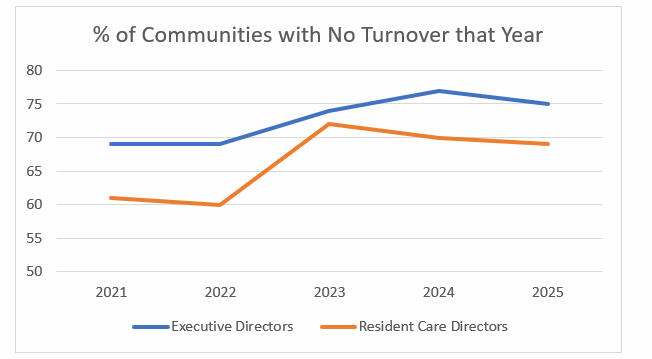
Leadership turnover remains consistent in the roles of the Executive Director and Resident Care Director in recent years. The largest improvement in retention in these roles came following 2022, and it remained steady between 2024 – 2026. About 25% of assisted living communities had more than 1 executive director in a year, and about 30% had more than 1 resident care director. This trend may signal the need for a renewed focus on improving retention in these key positions.
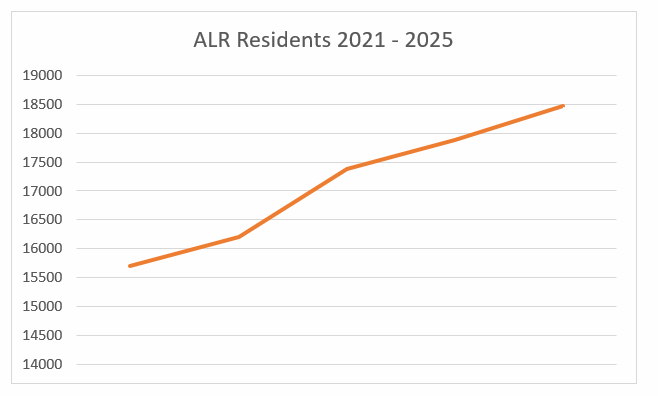
Median occupancy rates have remained consistent for a few years, remaining between 89-91% average occupancy rates for assisted living communities between 2023 – 2025. About 800 more residents were reported as living in assisted living in 2025 compared to the year prior, continuing to grow as shown in the chart below at a similar pace as the year prior. Interestingly, there were less total reported certified units in 2025 than in 2024. This drop may be in part due to having one less certified residence than the year prior, having four communities who did not complete the Census Report this year, or due to other factors not listed here.
Costs and fees for assisted living continue to rise. The highest reported monthly cost reported for traditional assisted living increased from $20,850 in 2024 to $22,630 per month in 2025. The highest reported monthly cost for special care also increased, though less significantly, from $22,215 in 2024 to $22,610 per month in 2025.
- The median lowest cost for traditional assisted living in 2025 was $4,450 per month (an increase of about $200 per month from 2024). The median highest cost for traditional assisted living in 2025 was $9,780 (an increase of about $500 per month from 2024).
- The median lowest cost for a special care unit in 2025 was $7,218 per month (no increase or decrease from 2024). The median highest cost for a special care unit was $11,985 (an increase of about $1,100 per month in 2024).
This year, the report included data on lift assists by assisted living providers. Of those, 57% of assisted living communities offered a 2-person lift assist; 37% offered a Hoyer list assist; and 33% offered a sit-to-stand lift assist. Also new this year, the report notes that 37% of all assisted living communities had an AED on site, 6% had an Epi-pen (or similar), and 5% had Narcan.
Also new this year, the report includes more detailed information about the use of contracted service providers in assisted living communities. The most common roles contracted by providers (in order of most common) are personal care attendants (PCA), licensed practicing nurses (LPNs), and registered nurses (RNs).
Participation in government assistance programs and dual-eligible health plans remains consistent in usage from year to year. Only about 11% of all assisted living residents participated in one of the following in 2025: Senior Care Options (SCO), Program for All-Inclusive Care of the Elderly (PACE), One Care, Group Adult Foster Care (GAFC), Section 8 Housing, or the MA Rental Voucher Program (MRVP).
There are many additional details, data points, and information about the assisted living sector in Massachusetts provided in the full 2026 Census Report. Dig into the details and see how your community compares to what’s reported across the state in assisted living. You can review reports from prior years here.
Please keep in mind that every certified assisted living residence in the state is required to submit this data to the Executive Office of Aging and Independence (AGE) each year. The data for the 2026 Annual report was collected in February 2026. The Massachusetts Assisted Living Association assists in helping AGE with this collection by reaching out to members to remind them to submit their community data each year by the deadline.
Thank you to everyone who provided data for this useful report! We hope you find the information to be valuable to your efforts. Please reach out to Christina Broughton at cbroughton@mass-ala.org with any questions about this summary or for a link to the full report.
_____________________________________________________________________________________
Check It Out: New and Current Member Spotlights!
We’re always keeping an eye out for any news and updates about our members and the broader assisted living community in our state. Check out our members in the news and what’s going on!
Welcome New Members
Welcome to our newest assisted living members! We are pleased to welcome everyone at the following communities into the network, who share our passion for advancing and supporting assisted living in Massachusetts.
Please join me in welcoming our newest assisted living members!
Welcome to our newest business partners! Our business partners provide a wide range of services and products to help assisted living communities in areas such as care management and operational support, payroll and HR solutions, and commercial cleaning services.
Torrey Enterprises, LLC/teachUCPR.com
Please join me in welcoming our newest business partners!
Member Spotlights
One Wingate East
Now open as the newest addition to the Wingate Living Collective, One Wingate East is an intimate boutique-style independent living community in the heart of Needham. Offering bespoke amenities and services designed exclusively for those seeking an independent lifestyle, it’s wellness-focused luxury living at its finest. Located on the campus of One Wingate Way, it’s an exciting new addition for existing and new residents alike.
Learn more here: https://wingateliving.com/locations/one-wingate-east

Sunbound
Sunbound is the AI-powered Revenue Operating System for senior living. We bring admissions screening, revenue cycle management, private payments, and working capital together in one platform, so operators get predictable cash flow and stay focused on resident care. Admissions screens a prospective resident’s financial viability before a bed is offered, running AI-powered background and credit checks in seconds, modeling spend-down and asset runway, and verifying active Medicaid or MCO coverage before move-in. Revenue Cycle Management runs the full claims cycle end-to-end, from eligibility and prior authorization through denial management, appeals, reimbursement, and reconciliation; Sunbound’s AI flags issues upfront so claims go out accurate the first time, and a team of billing experts handles the complex exceptions. Private Payments automates resident and family billing with invoicing, reminders, mobile check deposit, and a family portal that resolves questions before they reach staff, and AI-powered Billing QA checks every bill for accuracy before it goes out, so you capture exactly what you’re owed. Financial Agility turns receivables you’ve already earned into working capital, with no covenants and no lockboxes. Operators typically see a 99%+ net collection rate, 30% lower cost to collect, and 30% less bad debt, with over $1 billion processed on the platform annually. Sunbound is backed by Omega Healthcare Investors, Live Oak Bank, and leading Silicon Valley funds.
Learn more here: https://www.sunbound.ai

Christina Broughton
Manager of Member Engagement and Business Development